Action on Single-Use Plastics
Retailers are taking action on single-use plastics (SUPs), such as lightweight plastic bags, straws, cutlery, and other plastic items.
The National Retail Association supports the phase-out of single-use, unnecessary and problematic plastics to reduce litter, however for these to be successful and long-lasting, these changes must be:
- nationally consistent
- fair for all retailers regardless of size
- carefully considered and evidence-based
- commercially viable and realistic in a global market
- supported by retailer & consumer education
- supported by investment in Australian innovation & infrastructure
While some differences in timing are expected between states, critical differences between legislation are halting or reversing environmental progress. We call on local, state and federal governments to work together so retailers can invest in sustainability with certainty.
The National Retail Association is an active member of all state government taskforces and advisory groups.
We work with the whole supply chain – retailers, suppliers, recyclers, waste collection, activist groups, producers and charities – to bring unique insight, technical knowledge, practical experience and international evidence to help inform government policy decisions.
Our goal is to enable sustainable change that is practical, accessible, fair, and ultimately better for the environment rather than greenwashing.
Online information sessions
We run free monthly information sessions at which our single-use plastic ban expert, Ebony Johnson, provides an update across Australia and New Zealand regulations.
Register here: https://events.humanitix.com/plastics-bans-across-au-and-nz
Summary of single-use plastic bans (AU/NZ)
Download our Summary Table on current and proposed legislation (link updated regularly).
Please note that this table indicates which items are impacted by regulations in each jurisdiction, however it is important to note that the rules in each state vary dramatically for the same items. We recommend visiting each state ban website for the necessary detail.
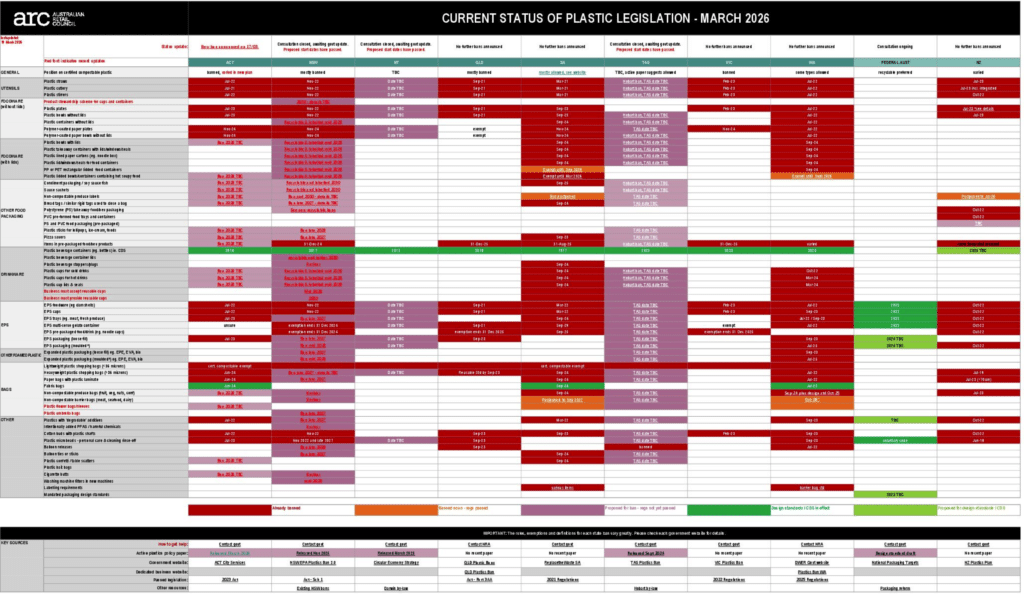
SCROLL DOWN FOR INFORMATION ON BANS IN EACH STATE
Single-use plastic bans by state
Need help with the WA or QLD bans?
The National Retail team are currently officially engaged by the QLD and WA governments to provide detailed business advice. For other bans, we recommend attending our monthly Plastic Bans across AU/NZ or contacting the particular government in question.
- Email us: sustainability@nationalretail.org.au
- Call our Sustainability Team: 1800 817 723 or 1800 844 946
- Attend an online session: https://events.humanitix.com/plastics-bans-across-au-and-nz
- Register for our sustainability updates: https://bit.ly/3I1z3VN
Below information current as of November 2024.
NSW Single-use Plastics ban
What’s banned?
From 1 June 2022, lightweight plastic shopping bags with handles that are 35 microns or less are banned in NSW.
From 1 November 2022, the following items are banned in NSW:
- Single-use plastic straws & stirrers
- Single-use plastic cutlery
- Single-use plastic plates
- Single-use plastic bowls without spill-proof lids
- Food containers & cups that are made from expanded polystyrene (EPS)
- Single-use plastic cotton buds
- Rinse-off personal care products containing plastic microbeads.
It is also an offence to display banned items, possess for supply and provide false/misleading info.
Items not in the list above (eg. cups, containers) will be reviewed in 2024.
Key notes
- Compostable plastics:
- banned for all items
- Exemptions:
- items in sealed pre-packaged food & bev before store by machine process
- distribution outside the state
- straws on request (not on display)
- plastic-coated paper plates & bowls (exemption ends 31 October 2024)
- cotton buds used for forensic, scientific or medical purposes
- also see detailed info on exemption applications >
- Defining single-use – 3 key criteria:
- Settings where items are ordinarily used once
- Diswashability (125 washes by Nov 2023, 780 washes by May 2024)
- Marketing
- See EPA guidelines >
More information
WA Plastics Ban *NEW AMENDMENT*
What’s banned?
STAGE 1 BAN
Banned from 1 January 2022:
- It is an offence to provide false or misleading information about items which are included in the ban.
Banned from 1 July 2022:
- All plastic shopping bags with handles (includes all thickness, includes polymer-coated paper bags, additional requirements for fabric bags)
- Disposable plastic straws & stirrers
- Disposable plastic cutlery
- Disposable plastic plates (incl. polymer-coated paper)
- Disposable plastic bowls without lids (incl. polymer-coated paper)
- Disposable plastic containers without lids (incl. polymer-coated paper)
- Food containers & trays that are made from expanded polystyrene
- Balloon releases (balloons not banned)
Banned from 1 October 2022:
- Disposable plastic cups for cold drinks (cup lids not yet banned)
Key notes
Compostable plastics:
- banned for most items
- except specific rules for paperboard products
Exemptions:
- items in sealed pre-packaged food & bev before store
- distribution outside the state
- straws on request (not on display)
- EPS trays used for raw meat or seafood
- other specific exemptions apply eg. airlines
STAGE 2 BANS
The National Retail Association has been engaged by the WA Government to assist businesses via a tollfree hotline (1800 817 723), a dedicated website for business (www.plasticsbanwa.com.au), and regular online sessions. The NRA team also undertook face-to-face visits of over 4800 stores in WA from January to September 2024.
Summary of the next bans:
Phase 2a – Supply banned by 1 September 2023
- Degradable plastic (incl. oxo-degradable and landfill degradable).
- Cotton buds with plastic shafts.
- Microbeads.
- EPS cups and EPS in food and beverage packaging (including meat trays)
- Loose fill expanded plastic packaging (including all forms of expanded plastic eg. EPS, EPE, EPP and bioplastic foam).
Phase 2b – Supply banned by 1 March 2024
- Takeaway coffee cups (excl. AU certified lined paper cups).
- Cup Lids and seals – hot & cold drinks (including plastic lined lids).
- Plastic trays for takeaway food not covered in the Stage 1 ban.
Phase 2c – Supply banned by 1 September 2024
- Plastic produce bags for loose, fresh fruit and vegetables, except certified compostable plastic produce bags.
- Lids, windows and heat-sealed film for takeaway food containers, trays and bowls (excl. AU certified lined paper lids).
- Lidded food containers, trays and bowls for takeaway and eat-in applications. There is a limited exclusion that allows plastic lids/windows for takeaway food that is pre-packed and placed on display for sale.
- * New time-limited exemptions apply
Phase 2d – Supply banned by 1 July 2025
- Moulded expanded plastic packaging (including all forms of expanded plastic eg. EPS, EPE, EPP and bioplastic foam)
- * New time-limited exemptions apply
WA Design Standard for produce/barrier bags
From 1 September 2025, all barrier bags provided in Western Australia must comply with a mandatory design standard as part of Stage 2 of WA’s Plan for Plastics.
Mandatory Design Standard
Barrier bags used for loose fresh produce, dry goods, meat, seafood, and dairy products will be required to meet new compostability and design standards. The intent of the change is to reduce single-use plastic waste and improve the compatibility of bags with Food Organics Garden Organics (FOGO) processing systems.
Under the new requirements, all barrier bags must be plastic-free (e.g. paper, reusable fabric) or meet the following mandatory requirements:
- Be certified compostable to an Australian composting standard (AS 4736 and/or AS 5810);
- Be labelled on the bag with the ABA compostable logo and unique certification number;
- Have a minimum opening circumference of 740 mm (manufacturing tolerances excluded) – only applies to bags used for loose fresh fruit and vegetables;
- Be clear or semi-transparent (not opaque). Untinted or green tinted bags are acceptable; and
- Have no handles.
There are further recommendations in the Design Standard, such as min. 8L capacity and additional printing or tinting, though these are not mandatory.
The Design Standard does NOT apply to:
- barrier bags which do not contain any amount of polymer;
- reusable produce bags made from plastic fabric, such as polyester or nylon;
- plastic bread bags or bags used for loose baked goods;
- bags used for goods that are pre-packaged (e.g. pre-packaged chicken/prawn/grape bags);
- bulk bags sold on-shelf (e.g. freezer bags, sandwich bags, zip-lock bags);
- zip-lock plastic bags for packaging loose goods, such as resealable bags used for dry bulk foods, including loose nuts and confectionery; or
- compostable plastic barrier bags that comply with the Design Standard.
More information
The National Retail team has been officially engaged by the WA Government to assist businesses to understand and prepare for the bans from 2023 to 2026.
Call our WA Hotline (1800 817 723) or attend our info sessions online. Register here >
ACT Single-Use Plastics Ban
What’s banned?
Banned from 1 July 2021:
- Single-use plastic cutlery & stirrers
- Foodware & cups made from expanded polystyrene (EPS)
Banned from 1 July 2022:
- Single-use plastic straws
- Single-use plastic cotton buds
- Oxo-degradable plastics
Banned from 1 July 2023:
- single-use plastic plates and unlidded bowls (exemption for plastic-lined paper plates and bowls until Nov 2024)
- expanded polystyrene (EPS) loose fill packaging
- expanded polystyrene (EPS) trays (including pre-packaged meat trays, etc)
- plastic microbeads in rinse-off personal care and cleaning products
Banned from 1 January 2024:
- all plastic shopping bags, including plastic-lined paper bags
- non-woven polypropylene bags must be 90gsm and have stitched seams
It is also an offence to provide false/misleading info.
Key notes
- Compostable plastics:
- banned for all items
- Exemptions:
- distribution outside the state
- straws on request (not on display)
- other specific exemptions apply eg. EPS gelato boxes, forensic/medical specific exemptions
- some exemptions are time-limited
More information
QLD Single-Use Plastics Ban
STAGE 1 BAN (2021)
What’s banned?
Banned from 1 September 2021:
- Single-use plastic straws & stirrers
- Single-use plastic cutlery
- Single-use plastic plates
- Single-use plastic bowls without lids
- Food containers & cups made from expanded polystyrene (EPS)
It is also an offence to provide false/misleading info.
Key notes
- Compostable plastics:
- Australian certified compostable plastic items are permitted (AS4736 or AS5810). National Retail Association does not recommend these given bans in other states.
- Exemptions:
- items in sealed pre-packaged food & bev before store.
- distribution outside the state.
- types of organisations are exempt from the 2021 ban (eg. medical) but retailers cannot provide straws.
- polymer-coated paper products plates and bowls.
STAGE 2 BAN (2023)
Further items are banned in QLD from 1 September 2023, including:
- plastic shopping bags with handles which do not meet 2 new requirements (80% recycled content and carry 10kg for 125 uses as verified by reusability tests)
- cotton buds with plastic stems
- expanded polystyrene (EPS) loose packaging (eg. packing peanuts)
- plastic microbeads in rinseable personal care and cleaning products
- balloon releases.
Detailed information on each item >
Some exemptions apply to specific items, but please note that organisation-wide exemptions in the 2021 ban do not apply to items in the 2023 ban.
The National Retail Association team continue to provide support and advice for businesses, including free online information sessions, visiting thousands of stores, manning a tollfree hotline, and specific factsheets for businesses.
FURTHER ACTION
In 2022, the Queensland Government published a Plastics Roadmap of single-use plastic items which are being considered for bans or other actions between 2023 and 2028. In 2023, a ban on select items was implemented, while other strategies were deployed to look into other items, such as the Beyond Cups Innovation Challenge.
Further bans have not yet been announced, as the Queensland Government is working with the Commonwealth Government and other jurisdictions for greater harmonisation of actions on problematic plastic.
The National Retail Association is working closely with Queensland Government who has confirmed that public consultation is a requirement prior to the commencement of further bans. Businesses seeking to be proactive are recommended to phase out unnecessary single-use plastics where possible.
More information
The National Retail team has been officially engaged by the QLD Government to assist businesses to understand and prepare for plastic bans.
SA Single-Use Plastics Ban
What’s banned?
Banned from 1 March 2021:
- Single-use plastic straws
- Single-use plastic cutlery & stirrers
Banned from 1 March 2022:
- Foodware & cups made from expanded polystyrene (EPS)
- Oxo-degradable plastics
Banned from 1 September 2023:
- Single-use plastic plates and unlidded bowls (exemption for plastic-lined paper plates and bowls until Nov 2024)
- Cotton buds with plastic stems
- Plastic pizza savers
Banned 1 September 2024:
- All plastic shopping bags with handles
- including plastic-lined/coated paper bags.
- does not include unsealed bags in which perishable food is offered for sale (e.g. hot chicken or grape bag) does not include pre-packaged sealed bags (e.g. bread bag).
- does not include synthetic fabrics such as nylon, polyester or woven PP. Non-woven PP must meet minimum requirements (like WA and ACT).
- reusable plastic bags will not be allowed regardless of thickness or recycled content.
- secondhand plastic bags reused by charities exempt until Sept 2027.
- Non-compostable plastic produce bags for all unpackaged fruit, vegetables, nuts, and confectionary
- plastic produce bags must be certified to an Australian composting standard, and labelled as compostable by September.
- Plastic bread bag tags and similar food bag tags
- includes rigid tags (not soft plastic tags, sticker closures or twist ties) that are used to close a bag of food.
- does not include rigid tags used for other purposes than closing a bag.
- time-limited exemption for potato and carrot bags 2kg or more until Sept 2029.
- plastic tags used to close bags of other produce are not exempt.
- Non-compostable single-use plastic beverage cups and their lids/seals
- disposable cups and their lids which contain plastic or bioplastic must be compostable and have commenced their AS certification process by September.
- businesses have until March 2026 to complete Australian composting certification and labelling on cups and their lids/seals.
- alternatives do not need to be fibre-based as long as they have achieved composting certification (i.e. pure bioplastics allowed, please note these are not allowed in WA)
- lids/seals less than 70mm in diameter do not need to be labelled.
- Single-use plastic beverage plugs/stoppers
- stickers and other non-inserted spill prevention devices allowed.
- Non-compostable single-use plastic food containers and their lids/seals/windows for ‘ready-to-eat’ food
- ‘ready to eat’ food is defined as prepared or packaged onsite at request of a customer, or prepared fresh and pre-packaged on the day, or shortly before the day, on which it is intended to be offered for sale, and is ready to be eaten without further cooking, heating, defrosting, washing or other preparation, and is ordinarily intended to be eaten onsite or shortly after leaving.
- containers and their lids (including bowls, wedges, clamshells, containers, tubs, windows, seals, etc) which contain plastic or bioplastic must be compostable and have commenced their AS certification process by September 2024.
- includes condiment containers which are provided with ready-to-eat food and packaged onsite.
- businesses have until March 2026 to complete Australian composting certification and labelling on cups and their lids/seals.
- alternatives do not need to be fibre-based as long as they have achieved composting certification (i.e. pure bioplastics allowed, please note these are not allowed in WA)
- exemptions:
- time-limited exemption until Sept 2029 for transparent square or rectangular plastic food containers with a detachable lid, if both the lid and base are wholly made from PP or PET.
- aluminium containers with a plastic-lined paper lid are exempt
- catering platters used for catering at a function or event are exempt
- lids/seals less than 70mm in diameter or containers less than 60mL in volume do not need to be labelled.
- *new exemption for specific food containers used for hot potatoes, gravy or peas – see government website.
- expanded polystyrene (EPS) trays
- includes those pre-packaged for veges, meat and other foodstuffs
- other EPS food and beverage containers e.g. EPS gelato boxes previously not captured.
- plastic confetti
- pieces of plastic that are designed or intended to be thrown or projected into the air or otherwise scattered for decorative, festive or celebratory purposes.
- does not include sequins, diamantes, beads, glitter or any other pieces of plastic that are not designed to be thrown/released into air as its function.
- plastic balloon sticks and ties
- plastic balloon sticks and ties (i.e. clip or cap-style devices attached to the base of balloons) are banned
- balloons and other accessories such as balloon weights and other ties (e.g. string, ribbon) are not banned.
- non-compostable single-use plastic bowls
- Compostable plastic bowls were previously banned but will now be allowed. The ban on compostable plastic plates, straws and cutlery remains.
Banned 1 September 2025:
- non-compostable produce stickers POSTPONED
- In July 2025, the SA Government announced that the ban on produce stickers is paused with no new date confirmed. See announcement >
- single-use plastic soy sauce containers (30mL or less)
- pre-filled plastic containers with a cap, lid or stopper that contain 30mL or less of soy sauce.
- compostable plastic not allowed.
- attached cutlery, straws and pre-packaged EPS bowls or cups
- current exemption will end.
28 February 2026:
- exemption for containers with hot potatoes, gravy or peas ends.
1 March 2026:
- businesses must have completed Australian composting certification and labelled food and beverage containers as compostable, applies to: disposable plastic cups and cup lids/seals; and food containers, bowls, trays for ready-to eat food (other than transparent, rectangular detached lid containers).
- Also see above Sept 2024 exemptions re size, aluminium containers with plastic-coated lids, catering platers – we believe these remain exempt (no end date).
1 September 2027:
- Non-compostable unlabelled barrier bags for unpackaged meat, dairy and fish
- these bags must be certified to an Australian composting standard, and labelled as compostable by September 2027.
- Exemption ends for secondhand plastic bags reused by charities (see above Sept 2024 exemption).
1 September 2028:
- Exemption ends for produce stickers/labels using international composting certification, and they must have completed Australian composting certification (see above Sept 2025 exemption).
1 September 2029
- Exemption ends for transparent square or rectangular plastic food containers (see above Sept 2024 exemption).
Have questions?
Visit the SA Government plastic ban website: https://www.replacethewaste.sa.gov.au/ or contact Green Industries SA (GISA) on (08) 8204 2051
More information
VIC Single-Use Plastics Ban
What’s banned?
Banned from 1 February 2023:
- Single-use plastic straws and stirrers
- Single-use plastic cutlery
- Single-use plastic plates
- Food and drink containers made from expanded polystyrene
- Single-use plastic cotton buds
It is also an offence to provide false/misleading info.
Key notes
- Compostable plastics:
- banned for all items
- Reusability:
- ‘Reusable’ items are defined as a plastic item that is manufactured: to be used for the same purpose on multiple occasions, and with a warranty (or other written representation) of at least one year.
- Exemptions:
- items in sealed pre-packaged food & bev before store
- distribution outside the state
- straws on request (not on display)
- plastic-coated paper plates (exempt until 1 Nov 2024)
- other specific exemptions apply
More information
TAS Single-Use Plastics Ban
Tasmania has announced their intention to take state-wide action on single-use plastics.
The Discussion Paper and survey closed 1 October 2024.
The paper outlines proposed bans (timing unclear) on:
- plastic shopping bags
- plastic barrier and produce bags
- single-use plastic straws, cutlery, stirrers
- single-use plastic bowls and plates
- single-use plastic food containers
- single-use plastic cups and lids
- EPS fruit & vege trays & gelato containers
- Expanded plastic packaging – loose and moulded
- Microbeads
- Balloon sticks and ties
- Cotton buds
- Pizza savers
- Lollipop sticks
- Plastic confetti
- Plastic bread tags
- Plastic-lined noodle boxes
- Fruit stickers/ produce labels
- Condiment sachets and packets
- Pre-packaged and attached items from above
More information
Hobart
The City of Hobart implemented a ban in 2020 which includes:
- single-use plastic takeaway packaging that is smaller than one litre or an A4 sheet of paper AND
- is prepared onsite for immediate consumption
Items include:
- Plastic cutlery
- Plastic straws
- Plastic takeaway food containers and lids
- Plastic lined noodle boxes
- Plastic lined coffee cups
- Plastic lids on takeaway cups
- Plastic sandwich wedges
- Sauce sachets (e.g. tomato, soy, tartare)
Key notes
- Compostable plastics:
- certified compostable allowed for all items (Australian Standard AS4736, European Standard EN13432, United States of American standard D6400)
- Exemptions:
- items in sealed pre-packaged food & bev before store
- distribution outside the council area
More information
NT/ Darwin Single-Use Plastics Ban
The Northern Territory has announced plans to implement a single-use plastics ban by 2025. We are awaiting further information on progress.
Items being considered for the 2025 ban include:
- Plastic shopping bags (heavy weight)
- Plastic straws
- Plastic utensils and stirrers
- Plastic bowls and plates
- EPS consumer food containers
- EPS consumer goods packaging (loose fill and moulded)
- Microbeads in personal health care products
- Helium balloon (releases)
The City of Darwin implemented a ban from use on council land from 1 January 2019 on single use plastic items including disposable coffee cups, smoothie cups, lids, straws, cutlery, stirrers, plates, bowls and takeaway containers.
New Zealand Single-Use Plastics Ban
What’s banned?
Banned from 1 October 2022:
- Cotton buds with plastic stems or with synthetic fibre
- Plastic drink stirrers
- Oxo- and photo-degradable plastic products
- Certain PVC food trays and containers
- Polystyrene takeaway packaging
- Expanded polystyrene (EPS) food and beverage packaging
Banned from 1 July 2023:
- Plastic produce bags for fresh unpackaged fruit and vegetables
- Plastic straws
- Plastic cutlery
- Plastic plates & bowls
- Plastic produce labels
All other PVC and polystyrene food and drink packaging will likely be phased out by mid-2026. Regulations have not been released.
Key notes
- Includes PVC trays and containers used for meat fish and poultry, fresh produce and baked goods only
- Includes Expanded Polystyrene sold at retail, including food service, and form-fill-seal pre-packaged
- Polystyrene takeaway packaging used to pack ready-to-eat food and beverages for immediate consumption, exempting pre-packaged off-site
- Exemptions for cold chain transport and protective packaging EPS.
- Exemptions for single-use cotton buds used for medical or scientific purposes.
More information
- Information on New Zealand ban
Report non-compliance
Thousands of retailers are compliant or going beyond single-use plastic bans.
To ensure a level-playing field for business, we encourage government to take action on non-compliant businesses, especially online and imported product.
Any business or member of the public can report suspected non-compliance for investigation by the relevant government:
- Queensland: Submit a report form here: https://qldplasticsban.com.au/resources/report/
- New South Wales: plastics@epa.nsw.gov.au
- Victoria: Submit a report form here: https://portal365.epa.vic.gov.au/pollution-report-form/
- Western Australia: complianceforplastics@dwer.wa.gov.au
- South Australia: EPASUPteam@sa.gov.au
- Northern Territory: ntepa@nt.gov.au
- Australian Capital Territory: singleuseplastics@act.gov.au
- Tasmania: PlasticsPolicy@nre.tas.gov.au